How To Find Your Property On FEMA’s Flood Insurance Rate Maps

What are FEMA flood maps?
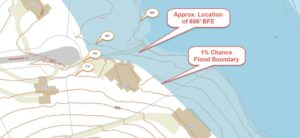
FEMA’s Flood Insurance Rate Maps (FIRMs) or just Flood Maps are provided after a flood risk assessment has been completed or updated for a community.  This study is known as a Flood Insurance Study.  The FIRM gives you the Base Flood Elevations (BFEs) and insurance risk zones in addition to floodplain boundaries.  The FIRM may also show a delineation of the regulatory floodway.

Once the “insurance risk zone”  (commonly referred to as the flood zone) is determined, actuarial rates, based on these risk zones, are then applied for newly constructed, substantially approved, and substantially damaged buildings.  FEMA uses these rates to determine the insurance rate you will pay for flood insurance

FEMA’s Digital Flood Maps

FEMA discontinued the production and distribution of paper flood maps in 2009 as part of its Digital Vision Initiative. This affected all the Flood Maps, boundary information, and study reports. However, clients can still view the products for free through their website or buy them in digital format.

To view these flood maps online, go to FEMA’s Map Service Center and key in your address (hi-lited area shown here) search for your home.  This will prompt you to then select the map that covers your area.  The Flood Maps are somewhat cumbersome to use online. It is best to go through the tutorial on the bottom right of the address search page for an easier and more effective use of the GIS map.

author avatar
Surveyor

More Posts

Why Property Line Surveys Are Rising in Salt Lake

A residential boundary survey plays a key role in understanding property limits, especially in areas where growth is accelerating. In Salt Lake, ongoing housing demand and zoning changes are reshaping how land is used across long-established neighborhoods. As more properties are updated, subdivided, or repurposed, boundaries that once seemed clear

Read More »
Residential home with surveying equipment and flood zone map showing potential risk, illustrating the purpose of an elevation certificate
flood damage
Surveyor

Do You Need an Elevation Certificate? Find Out Now

Buying a home should feel smooth. You find the right place, agree on a price, and move toward closing. However, many buyers are surprised when a lender or insurance company suddenly asks for an elevation certificate, and you start wondering why it may be required in the first place. At

Read More »
Surveyor using equipment to perform a construction survey on a road project site
land surveying
Surveyor

What a Construction Survey Must Get Right on Roads

Lehi, Utah keeps growing fast. New roads stretch across the city, and new developments follow close behind. You may see machines, crews, and materials on site. However, before any of that work begins, something very important happens first. It starts with a construction survey. A construction survey takes the plans

Read More »
Side-by-side aerial imagery showing how a property and surrounding land changed over time with new homes and roads appearing
land surveying
Surveyor

Check the Capture Date of Aerial Imagery Before Using It

Many people use aerial imagery when they want to learn more about a piece of land. In fact, it often becomes a starting point for aerial imagery for property research, especially when buyers, builders, or property owners want a quick view of the area. At first glance, these images look

Read More »
Land surveyor measuring a development site before construction planning begins
land surveyor
Surveyor

The Hidden Role of a Land Surveyor in Development Projects

Provo keeps growing. New homes, new businesses, and new roads appear across the city every year. Recently, people started talking about a large project planned for the East Bay area. Many discussions focus on utilities, traffic, and land use. However, before any big project begins, one expert plays a very

Read More »
House staking layout with string lines marking foundation corners before concrete pour
construction
Surveyor

House Staking Checklist: 12 Steps Before You Pour Concrete

If you’re building a home, there’s one step that quietly controls everything that comes next: house staking. Before excavation starts. Before forms go in. Before concrete trucks show up. House staking marks the exact location of your future home on the lot. It sets the corners, confirms setbacks, and locks

Read More »